
Demax Patents Method of Application for Full-Face DOVIDs

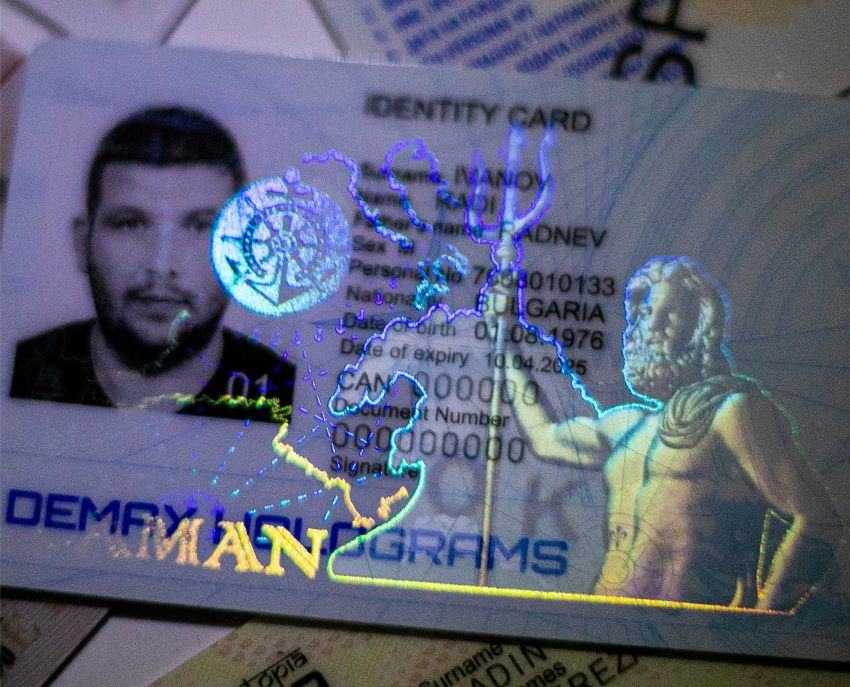
Bulgarian security foils supplier Demax Holograms has developed and patented a novel method of application of full-face DOVIDs for polycarbonate documents including passport data pages, ID cards and driving licences [1]. According to the company the new method is a game changer, as it visually increases DOVID’s optical brightness compared to existing full-face DOVIDs, provides for integration of features that cannot be incorporated using other methods and, most crucially, ensures polycarbonate document’s structure and the optical quality of embedded images are not affected by laser engraving.
Current limitations
Until recently, DOVIDs for polycarbonate documents have been limited to localised applications in the form of a patch embedded into the document and transferred onto polycarbonate by a hot-stamping process using adhesive and pressure. The patch typically covers a 20 x 20 mm area protecting part of the document holder’s picture and some of the biographical data. As a result, DOVID design has been confined providing limited security and visual effects. The use of adhesive has also been a major drawback as it impacts DOVID’s optical brilliance over time.
Utilising non-polycarbonate material, including adhesive, within the document’s monolithic polycarbonate structure has been the main reason larger DOVIDs have not been an option in the past. Non-polycarbonate material can affect adhesion of adjacent polycarbonate layers in the document as well as cause their separation when the document is personalised using laser engraving. The heat generated by laser beam can also cause bubbling and affect DOVID’s visual appearance destroying its optical effects. And, whilst some suppliers offer embedding the foil selectively to avoid the areas where the document is laser engraved the solution equally limits DOVID’s design and security of the whole document.
The development of large DOVIDs, now known as full-face holograms, covering the entire card or passport data page surface has seen suppliers introduce a mixture of cold transfer foils and direct embossing for their application. Large DOVIDs offer a number of benefits compared to traditional hot-stamping transfer foils. With no limitations as to their size or shape and their design they provide enhanced visual effects and the best security available ensuring more reliable inspection and authentication of documents. And, where adhesive is not used, they can guarantee full brilliance of the imagery for the whole lifespan of an ID card or a passport.
As a method of application, cold transfer foils have been shown to present a number of issues including bubbling when the document is laser engraved. Cold transfer foils have also limitations in terms of features that can be included in the DOVID.
Direct embossing where diffractive structures are embossed onto polycarbonate with no use of adhesive typically requires the use of lacquers to protect the DOVID from heat during card lamination and subsequently personalisation and improve its durability. Lacquers, however, have also been shown to cause issues, particularly separation of adjacent layers in card’s structure when laser engraved. They can also impact DOVID’s optical brilliance giving it an orange-yellow hue when the document is assembled and its layers are heat-fused.
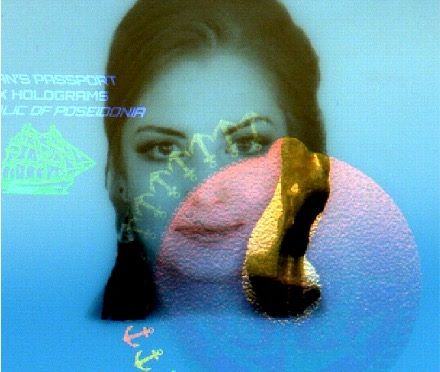
Alternative techniques where instead of lacquers a weblike mesh structure is created on polycarbonate surface when DOVID is embossed have also shown their limitations. The mesh is visible to the naked eye impacting on optically variable effects. And the heat generated by laser engraving continues to be a major issue affecting DOVID’s appearance.
Benefits of the new process
Demax’s method utilises a proprietary micro raster technique and has been developed to ensure DOVID’s appearance is not impacted by laser engraving. The technique also provides maximum known resistance to separation of card layers. Card peel strength test mandated by ISO/IEC 10373 requires this remain intact at 3 N pull force. Demax’s method produces resistance that is three times more than the required minimum ensuring the document is not affected when laser engraved. The raster cannot be observed and increases DOVID’s optical brilliance compared to other techniques as well as allowing integration of complex forensic and nano features.
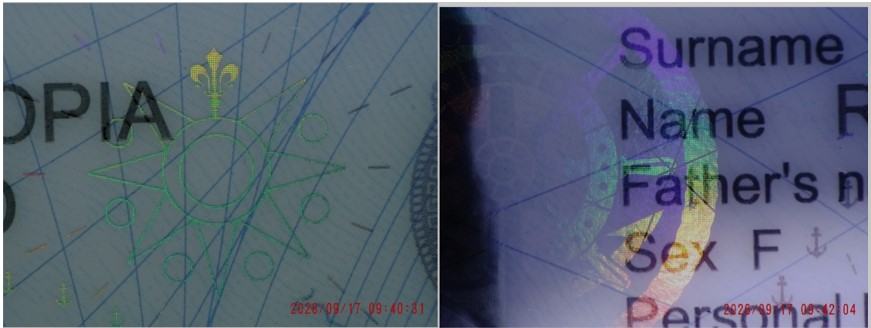
Supplied pre-embossed on polycarbonate in reel or sheet form depending on document manufacturer’s requirements, the product is now available under Demax’s E-LIDOGRAM® brand. E-LIDOGRAM® is Demax’s proprietary origination based on cutting-edge electron beam lithography with resolution of 8 nanometres and has been designed to generate nano-optical elements with unique effects distinct from conventional holograms.
Commenting on the development, Demax’s CEO and Head of R&D Valentin Monovsky said: ‘We continue to prioritise innovation as a cornerstone of our development and growth, placing strategic focus on creating new technologies to supply our customers with best-in-class products. The latest advance solves existing issues with DOVIDs caused when documents are laser personalised and will allow document manufacturers and governments to provide their citizens with better quality travel and identity documents.’
[1] - EP4615701A1 / WO2025045748A1
Get the Holography & Optical Technology News™ Weekly delivered free to your inbox.