
KAIST Develops Light-Based Artificial Fingerprints

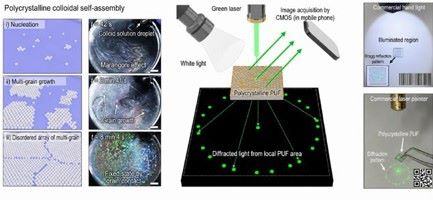
A research team led by Prof Sang Ouk Kim from Korea Advanced Institute of Science and Technology (KAIST) and Seok Joon Kwon (Sungkyunkwan University) has developed a new authentication technology that uses randomly assembled nanoparticles to create unique ‘artificial fingerprints’.
The technology uses a physical unclonable function (PUF), a security method that relies on unique physical features formed during manufacturing. Like human fingerprints, these tiny structures are very hard to copy, even if the same materials and processes are used.
The researchers created the artificial fingerprints by self-assembling spherical nanoparticles, each hundreds of nanometres in size, on a water surface. This process produces microscopic structures containing multiple crystalline regions with different sizes and orientations. Each assembly creates a distinct pattern, making exact replication extremely difficult.
Subscriber content
Read the full article
Full access to Holography & Optical Technology News™ articles, newsletters and archives.