
From Advanced Origination to Industrial Optical Security


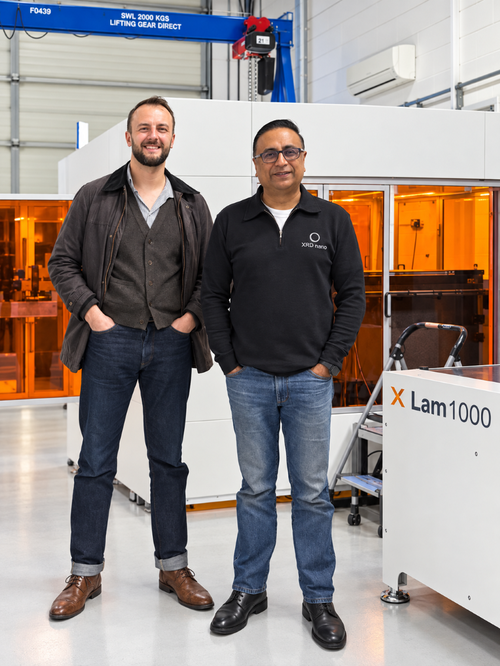
As optical security features grow more sophisticated, the industry faces a bigger challenge: moving advanced structures from mastering to reliable, high-volume production. Holography & Optical Technology News™ spoke to Felix Eggert, Area Sales Manager at RAITH overseeing Laser Lithography, and Guri Dhillon, founder of XRD Nano, to discuss how they are working together to address this challenge.
RAITH, headquartered in Germany with laser lithography operations in the Netherlands, specialises in maskless nanofabrication and mastering, while UK-based XRD Nano focuses on the industrial replication of micro- and nanostructured surfaces.
RAITH has an installed base of more than 1,300 systems across its various technologies, including more than 250 maskless laser lithography systems, while XRD Nano has supplied more than 45 UV recombiners and roll-to-roll (R2R) UV casting systems.
Q: What brings RAITH and XRD Nano into dialogue, and where do you see the technologies complementing each other?
Felix: The connection is quite natural. RAITH focuses on pushing the limits at the mastering stage, while XRD Nano brings expertise reliable, cost-effective industrial replication.
By bringing these perspectives together, we can better understand how early design decisions influence manufacturability further down the line. Ultimately, it is about ensuring that innovation does not stop at the master.
Guri: RAITH is pushing what is possible at the origination stage, with increasingly sophisticated structures, higher resolution and greater design freedom. XRD addresses the next question: once a master has been created, how do you reproduce its functionality reliably over much larger areas and ultimately at industrial web speeds?
A master should not be designed in isolation from the process that will replicate it. RAITH expands the design space; XRD expands the manufacturable design space.
Q: Traditionally, optical security has been linked with holograms and diffractive elements. In your opinion, what changes are taking place in the technology landscape?
Felix: Optical security design has traditionally relied on the creativity and expertise of specialised designers. Today, AI and inverse-design tools are accelerating this process, allowing more complex concepts to be explored and optimised.
Conventional binary lithography is very effective at creating planar and multilevel features. Grayscale laser lithography, in contrast, is particularly well suited to creating complex surface-relief profiles and multilevel structures. By spatially modulating the exposure dose, it enables controlled 2.5D resist profiles to be generated after development. This increased design freedom is driving interest in advanced nano- and micro-optical structures capable of creating unique visual and security effects.
Guri: Security features are moving beyond conventional diffractive effects. We are seeing increasing interest in micro-optics, microlens arrays, deep structures, complex surface relief, and combinations of diffractive and refractive elements.
Designers now have much more capable origination technologies. This creates new opportunities, but also a manufacturing challenge. As the master becomes more sophisticated, replication must be more controlled.
Q: Why should origination and replication be considered as one connected development process rather than two separate stages?
Felix: The final result is determined by the combination of the master and the replication process. It is therefore important to consider them as a single continuous process and to account for process compatibility and production limitations from the outset.
Advances in lithography and replication technologies are also helping to narrow the gap between innovative optical concepts and scalable manufacturing.
Guri: Because what is theoretically manufacturable and what is robustly manufacturable at scale are not the same thing.
The master determines the geometry, but replication introduces material behaviour, shrinkage, release, curing, pressure, web tension and dimensional stability. If these variables are considered only after the master is complete, you can discover too late that a beautiful optical effect has a very narrow production window.
Replication engineering should therefore be involved much earlier, so geometry, materials and manufacturing can be optimised together.
Q: In your opinion, what is the greatest gap between the design of advanced optical security features and their production in industry?
Felix: The biggest gap lies in translating advanced optical security designs into reproducible, high-quality industrial products. While designers continue to push the boundaries of what is possible, challenges remain in mastering, replication, material compatibility, feature fidelity, and maintaining consistent quality at production scale.
This becomes particularly challenging with high-aspect-ratio, fragile and multi-level structures, where maintaining fidelity during replication can be difficult.
Guri: The gap is not necessarily the ability to create an impressive structure once. The industry is very good at demonstrations.
The difficult part is reproducing that structure consistently across a useful area, at commercial speed and yield, while preserving the same optical response from the first metre to the millionth.
That transition from a successful demonstration to a controlled and repeatable manufacturing process is where the real challenge lies.
Q: What are the main technical and production bottlenecks involved in bringing these structures to scale?
Guri: I would put the major bottlenecks into four areas: transferring very fine or high-aspect-ratio geometry without loss of fidelity; managing dimensional changes caused by resin shrinkage, curing and substrate behaviour; producing large-area tooling without accumulating positional errors; and taking that tooling into roll-to-roll production while controlling coating, tension, curing and release.
A process that works perfectly on a small sample may behave very differently when the same structure is repeated over a much larger master or produced continuously at production speed.
Scale-up is therefore not simply making the machine larger; it is about measuring and controlling the complete process window, including inspection of the replicated structure during production.
Felix: Creating a high-quality master is the foundation for taking nanofabrication to mass production. A poor-quality master fundamentally limits the quality that can ultimately be achieved in replication.
E-beam and laser lithography each have their strengths. E-beam offers exceptional nanoscale resolution, while laser lithography is particularly well suited to high-throughput grayscale fabrication, larger area patterning and high-relief 2.5D surface structuring. For advanced optical-security applications, the two technologies can provide complementary capabilities, combining resolution, design freedom, manufacturability and security performance.
Q: Can structures which appear technically impressive be difficult or uneconomic to produce on a large scale?
Guri: Absolutely. It is quite easy to create something extraordinary that becomes commercially difficult to reproduce.
A structure may require a narrow viscosity range, difficult filling or release, excessive cure energy or a process window that disappears as production speed increases.
At XRD, we regard equipment and chemistry as one process. An exceptionally accurate machine cannot compensate for unsuitable resin behaviour, and excellent chemistry cannot compensate for poor positioning, coating or cure control.
The real question is therefore not simply 'can we make the master?' It is: 'can we reproduce its optical performance consistently, at the required speed, yield and production economics?'
Ultimately, the customer does not buy microns or nanometres. They buy repeatable optical performance at an acceptable cost per square metre.
Felix: Definitely. The limitations of mastering techniques are distinct from those of replication. The best way to avoid this trap is to consider the whole downstream process and its bottlenecks.
Features that can be mastered with a direct-write lithography tool may be complicated to replicate, resulting in costly development cycles. The best approach is design-for-manufacturability: work backwards from the desired optical effect and ensure that the final structure can be produced reliably at scale.
Q: At what stage should manufacturability be taken into account in the design process?
Felix: The earlier these considerations are brought into the discussion, the better. Designing an optical master is not just about achieving a particular visual effect; it is about understanding how that effect will move through the entire production chain.
Having this knowledge from the start helps guide design decisions and prevents manufacturability from becoming an afterthought. It ultimately saves time, reduces complexity and leads to better results.
Guri: From the beginning.
Not to restrict the designer, but to give the designer better information. If we know the target substrate, feature depth, production speed, coating thickness and curing route from the beginning, we can often achieve the same or better optical result with a structure that is easier to manufacture consistently.
Q: Can closer integration of origination and replication enable new optical security features?
Felix: Bringing nanofabrication and replication expertise closer together is not only about improving existing features, but also about enabling entirely new ones.
Advanced nanofabrication technologies, including laser e-beam lithography, give optical designers greater freedom to explore structures ranging from freeform optics to metasurfaces and complex micro- and nano-optical geometries.
One example is the design of features that intentionally account for predictable replication effects. Rather than treating material shrinkage as a limitation, the master can be engineered so that the replicated structure reaches the desired dimensions after processing.
What may initially appear to be a process constraint can, when properly understood, become a powerful design tool.
Guri: That is where I think the real opportunity lies.
The objective should not simply be to reproduce today's holograms more accurately. If origination and replication are developed together, designers can begin considering structures that might previously have been rejected as too difficult to manufacture, such as combinations of micro- and nanoscale elements, deeper relief, refractive and diffractive structures, microlens systems and more complex optical responses.
That creates the possibility of entirely new families of security features rather than incremental improvements to existing ones.
Q: What do you think is the most promising area for these technologies in the field of optical security, and how should they be developed responsibly?
Felix: One of the most promising directions is the development of increasingly complex optical structures that combine advanced nanofabrication with design for manufacturability from the outset. As technology suppliers, we enable technological progress, but with that comes responsibility. It is important to understand how our tools are being used and what our customers aim to achieve.
This helps us build trusted partnerships while protecting intellectual property and know-how. Responsible deployment also means staying close to customers, understanding how the technology is being used, and supporting knowledge sharing through training, workshops and technical engagement.
Guri: For me, the most promising area is the development of hybrid optical structures that combine micro- and nanoscale, refractive and diffractive elements in ways that are designed from the beginning for industrial replication.
If advanced origination and replication develop together, we can create security effects that are not only more sophisticated visually, but also inherently more difficult to reproduce and capable of being manufactured consistently at scale.
These are enabling technologies, so responsible supply is equally important. We need to understand the customer, the application and the intended end use, protect intellectual property and know-how, and work with trusted participants in the security industry.
The objective should be to expand what legitimate customers can manufacture while ensuring that increasingly powerful technologies are deployed responsibly.
For more, contact [email protected] and [email protected].
Get the Holography & Optical Technology News™ Weekly delivered free to your inbox.