
Wires That Don’t Catch Fire: Vietnam Fights Fake Cables


Vietnam’s cable industry is experiencing rapid growth, with increased infrastructure investment and expanding manufacturing capacity. Meanwhile, counterfeit risk has shifted from isolated incidents to a systemic supply chain challenge.
Material substitution, label swapping, and grey market diversion have become common. Products now pass through several intermediaries, including manufacturers, distributors, contractors, and retailers, before reaching end users.
Each stage presents opportunities for substitution, reducing the effectiveness of traditional protection methods.
The $100 billion counterfeit challenge
This challenge is global in scope. Electrical and electronic goods are among the most counterfeited sectors worldwide, accounting for over $100 billion in illicit trade annually, according to OECD/EUIPO estimates.
The implications of this trade go beyond commercial loss. Substandard cables often use impure copper or volatile insulation, leading to rapid degradation and overheating. This shifts the conversation from brand protection to public safety.
According to the UK charity Electrical Safety First, faulty electrical products cause more than 7,000 house fires annually.
Vietnam faces similar risks. Local market surveillance authorities handle tens of thousands of violations annually.
The threat extends to critical infrastructure components. Recent enforcement actions in Vietnam have uncovered cases of counterfeit cable production involving material manipulation and misrepresentation of technical specifications. In documented instances, cables were manufactured with reduced conductive material while labelled with higher specifications, resulting in significantly lower performance in real-world conditions.
These cases highlight a fundamental issue: counterfeit practices in the cable sector are not limited to visual imitation, but extend to material-level fraud, directly impacting system reliability and public safety.
Optical authentication: a foundational standard
Traditional authentication methods, such as QR codes and SMS systems, are convenient but share a key vulnerability: they can be easily copied, transferred, or reused. Without a security identifier physically attached to the product, digital systems may validate substituted items. Fragmented protection is insufficient; the industry needs a unified standard anchored at the product’s physical origin.
Optical authentication addresses this gap by embedding identity at the material level. Advanced features, such as diffractive micro-structures, create visual effects that are easy to verify but cannot be replicated with conventional printing. These features rely on precise surface engineering, providing a ‘trust anchor’ that resists high-tech copying.
This is especially important in field conditions. Optical features enable contractors and electricians to confirm authenticity instantly by sight, offering immediate assurance of safety before any power is applied, said Tín Dân, an IOTA member in Vietnam.
The CADIVI phygital model
Vietnam Electric Cable Corporation (CADIVI), the country’s leading wire-and-cable manufacturer, provides a practical example. The company has adopted a ‘phygital’ approach, combining physical security with digital systems.
While its digital platform supports reward programs and logistics, CADIVI places strategic emphasis on optical features as the first line of defence. CADIVI uses three-dimensional optical security labels on its products. When illuminated, these labels produce a distinctive visual effect that is easily visible to the naked eye.
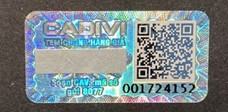
The structured design makes replication difficult with conventional printing or copying methods, providing a reliable physical check alongside digital verification.
The order of authentication is critical. In Vietnam’s multi-layered distribution network, product identity must be secured at the origin. Digital systems should then provide monitoring, traceability, and transparency throughout the supply chain. Without a secure physical anchor, digital tools may validate compromised products.
In summary, this integration signals a broader shift in security philosophy.
As a member of the International Optical Technologies Association (IOTA), Tín Dân supports this transition by aligning global authentication standards with Vietnam’s market needs. The focus is on designing coherent deployment architectures that effectively integrate physical and digital layers, rather than simply adding more technologies.
Get the Holography & Optical Technology News™ Weekly delivered free to your inbox.