
China’s Commemorative Series: A Platform for Innovation

‘China thinks in centuries, not in years’ – Henry Kissinger, former US Secretary of State & author of book ‘ON CHINA’.
This perspective underpins the People’s Bank of China’s Chinese commemorative banknote series. More than a cultural initiative, it reflects a structured, long-term approach to advancing innovation in its modern currency.
Led by China Banknote Printing and Minting Corporation (CBPM), the programme seems to be a clear strategy: deploy, refine, and scale innovation over a 12-year cycle. CBPM will issue 12 such notes in total, one per year, all to be produced on polymer at the company’s new printworks in Guangzhou.
2026: Year of the Fire Horse
The latest issue is the commemorative CN ¥20 banknote for the Year of the Horse, produced by Guangzhou Banknote Printing Co Ltd (GBP), part of CBPM.
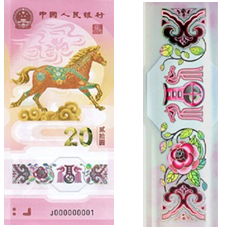
Fig 1: L to R: The CNY 20 commemorative banknote and the character. Fu (福) features a three-dimensional dynamic ring with exceptional brightness.
GBP is a modern, large-scale enterprise with comprehensive capabilities in R&D and production, both of paper and polymer banknotes. The latter boasts a complete manufacturing system that covers substrate coating, hot stamping, printing, quality inspection, and plastic-sealed packaging. It is also equipped with five major modules – analysis & testing, optical experimentation, material preparation, ink formulation, and pilot-run proofing, alongside 12 functional laboratories. It is committed to research on cutting-edge anti-counterfeiting materials as well as the development and industrialisation of polymer banknote products.
The design is themed around the Chinese character Fu (福), which is positioned at the visual centre of the transparent window, with images of the horse on either side. They are flanked by camellia flower motifs and auspicious cloud patterns, which, in traditional Chinese culture, symbolise resilience, humility and nobility, and correspond directly to the camellia patterns on the reverse of the banknote.
Below the horse motif is a LiveColor® dynamic colour-shifting stripe and transparent window. CBPM’s latest ColorSpace® 3D curved-surface optical technology is utilised in the wide stripe. It is a synthesis of techniques such as ColorTrace®, ColorClois®, holography and relief. Despite the limited space, it showcases a rich cyan-green colour shift and a vivid sense of three-dimensional depth.
A total of 100 million notes were issued, alongside 100 million 10 yuan bi-metallic coins. Demand was strong, with online allocations selling out within minutes.
Year of the Dragon and Snake
The latest series began with a strong foundation. The 2024 note features a multicoloured dragon in gold, green, and red – symbols of prosperity and auspiciousness. A holographic LiveColor stripe overlays a transparent window, revealing dynamic imagery including Ruyi cloud patterns and the Fu character.
The reverse depicts a dragon lantern dance, reinforcing festive themes. The transparent window design draws from Ruyi garden forms, demonstrating early integration of cultural motifs with optical security.
The 2025 issue builds through the integration of optical and design elements. The vertically oriented note features a central snake motif, a SPARK optically variable denomination, and a refined LiveColor stripe over a transparent window.
The optical feature delivers clear colour transitions when tilted, improving both usability and authentication. The reverse expands the cultural narrative, showing children hanging Spring Festival couplets alongside architectural elements from Shanxi Province and multilingual text reflecting China’s ethnic diversity.
Going back further
China has used commemorative banknotes as a structured platform to mark national milestones, technological progress, and cultural identity. The programme began in 1999 with the red CN ¥50 note celebrating the 50th anniversary of the People’s Republic, featuring Mao Zedong.
This was followed by the 2000 CN ¥100 polymer note marking the new millennium, introducing advanced substrates and symbolic imagery such as the dragon and the China Millennium Monument. Printed by CBPM on a Guardian® polymer substrate in partnership with Reserve Bank of Australia and UCB of Belgium – it was its first polymer banknote.
The security features include a clear window featuring a Hall of Prayer for Good Harvest at the Temple of Heaven, a shadow above the window reading ‘2000’, an Optically Variable Device (OVD) featuring a lantern with Chinese characters that represent the new millennium at the upper-right, and micro-printing of ‘100’ and ‘RMB’ in separate alternating lines across the top of the back of the note along either side of the China Centenary Altar in Beijing.
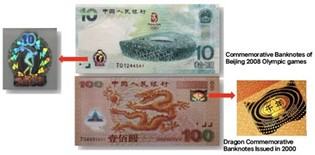
Fig 2: Security patch in commemorative banknotes (source: ZSST).
Subsequent issues aligned with global events and national achievements. The 2008 CN ¥10 note highlighted the Beijing National Stadium for the Olympic Games, while the 2015 ¥100 note focused on aerospace science and technology. In 2018, a CN ¥50 note marked 70 years of the Renminbi, reinforcing currency heritage.
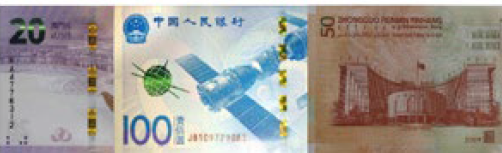
Fig 3: Security threads in commemorative banknotes 20, 50 & 100 Yuan (Source: ZSST).
More recently, China has combined innovation with event-led themes. The 2021 CN ¥20 Winter Olympics notes were issued in both paper and polymer, showcasing dual-substrate capability. The banknotes showcase the various optical effects (ColorTrace®, ColorDance®, and Moire amplification) that give the stripes a shimmering vitality, enhancing the snow, lanterns, and the Great Wall depicted on the notes.
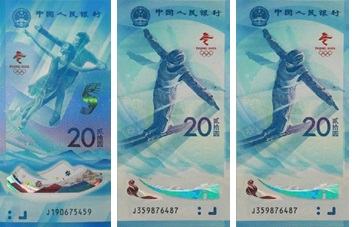
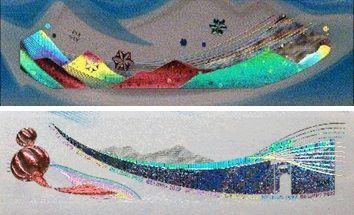
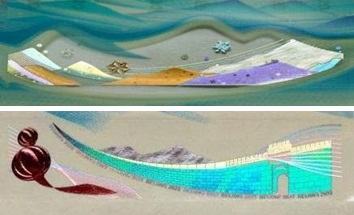
Fig 4: Winter Olympics commemorative banknote, straight and tilted view of banknote stripe.
Since 2024, the annual CN ¥20 zodiac series has established a long-term issuance strategy, positioning commemorative notes as a consistent platform for controlled testing, incremental refinement, design evolution, and optical innovation, thereby shaping authentication habits among the public at large.
Get the Holography & Optical Technology News™ Weekly delivered free to your inbox.