Light as the Key: KAIST Creates New Hologram Technology for Future Security


Researchers at the Korea Advanced Institute of Science and Technology (KAIST) have created a new hologram technology that uses light’s own properties as an encryption key, posing a far greater challenge for those looking to counterfeit security features.
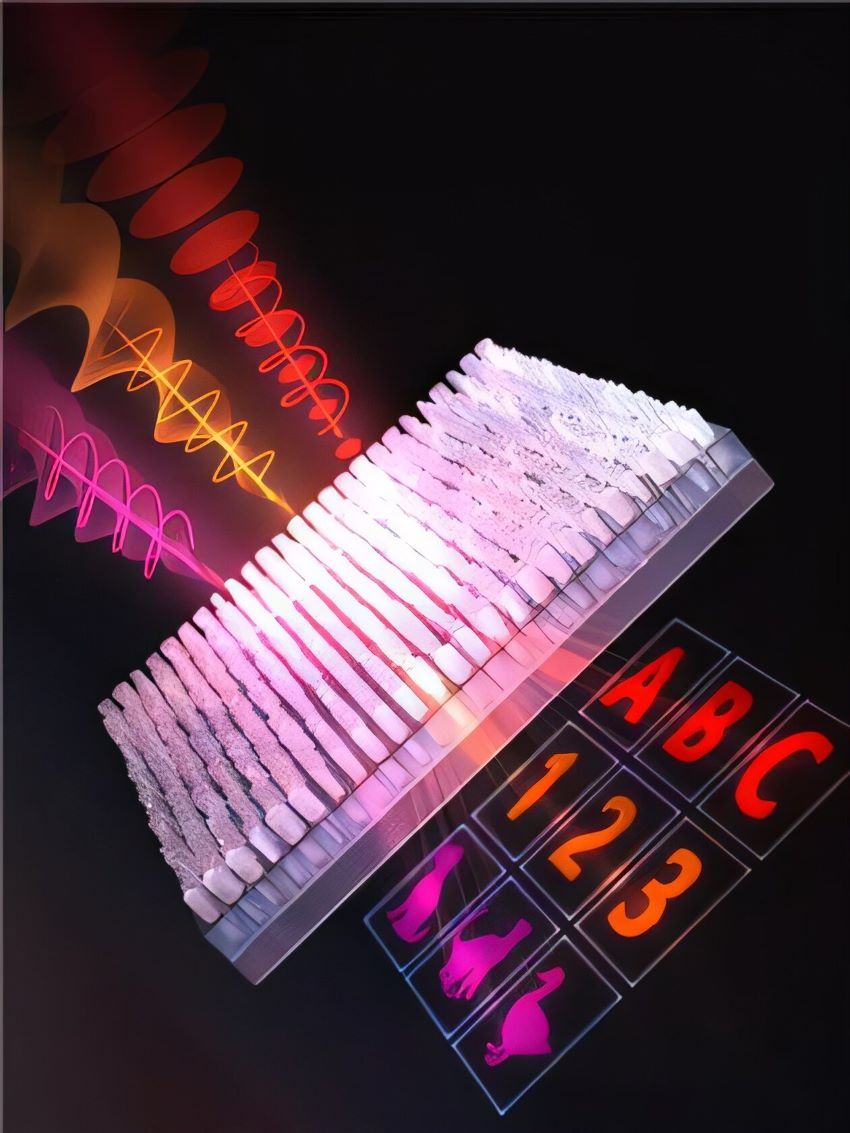
Conceptual diagram of the study (© The Korea Advanced Institute of Science and Technology (KAIST).
The breakthrough, led by Prof Jonghwa Shin from KAIST’s Department of Materials Science and Engineering, introduces a next-generation vector hologram metasurface capable of revealing different three-dimensional images depending on the state of the incoming light. The findings were published in the Advanced Materials journal, with Dr Joonkyo Jung serving as first author.
Unlike conventional holograms, the new system relies on the total angular momentum (TAM) of light – a combination of two fundamental optical properties: polarisation, which describes the direction in which light vibrates, and orbital angular momentum (OAM), which refers to the twisting or helical nature of light.
By combining these properties into a single optical key, the researchers created a security mechanism that only reveals hidden information when illuminated with precisely matched light conditions. Even if the light appears identical to the human eye, the encoded information remains inaccessible without the correct optical key.
To make this work, the team built a bilayer metasurface made of tiny structures much smaller than a human hair. Metasurfaces are special optical devices that control light at very small scales, allowing for new ways to shape how light behaves.
One big achievement in this study is being able to control polarisation and OAM separately in one device, something that has been very hard to do in optics. This is the first time a vector hologram has been shown to control both the strength and direction of light at the same time.
This technology could also help with sending data. Since OAM can take on many different forms, one beam of light can carry much more information. This could lead to very high-capacity optical communication.
Besides security, this new technology could be used in future displays, like immersive holograms, smart glasses, and systems for augmented reality (AR) and virtual reality (VR).
For the authentication industry, the implications are particularly noteworthy. Security labels and anti-counterfeiting features based on optical keys embedded in light itself could provide a powerful new defence against increasingly sophisticated counterfeiters.
‘This study demonstrates that polarization and twist, which are fundamental properties of light, can be combined into a single independent information key and freely utilised’, said Professor Shin. ‘It will evolve into a key platform for security systems that are difficult to replicate and for ultra-high-speed, ultra-high-capacity optical communication technologies.’
Get the Holography & Optical Technology News™ Weekly delivered free to your inbox.